Published on:

A friend recently made me aware of a publication by the Real Estate Center at Texas A&M called “Mineral Law West of the Pecos,” written by Judon Fambrough, a lawyer who is with the Center. Judon has written much good stuff about land and mineral law in Texas, and this publication is no exception. (The Center has many good articles and publications on its website of interest to land and mineral owners.) Judon’s article contains a good summary of the history of land grants in West Texas, mineral reservations, the Relinquishment Act and “mineral-classified” land, what constitutes a “mineral,” and recent litigation over State ownership of minerals in West Texas. His article is well written and informative and should be in every oil and gas lawyer’s library. The law of Texas land grants in West Texas (and South Texas) is complex and fascinating.

Judon provides this link to maps online at the Texas General Land Office, which show tracts in West Texas subject to any mineral classification or reservation by the State:

http://gisweb.glo.texas.gov/glomap/index.html

Published on:

The session is over, and the Texas legislature has failed once again to pass sunset legislation for the Texas Railroad Commission. The legislature instead authorized continuation of the RRC for another four years, with sunset review to be repeated in the 2017 legislative session.

Under Texas sunset act, every state agency must go through a comprehensive review of its functions and performance every twelve years by the Sunset Advisory Commission, a 12-member commission appointed by the Lieutenant Governor and the Speaker of the House. The RRC underwent sunset review in 2010; the report of the Sunset Advisory Commission at that time criticized the agency for failing to vigorously enforce its rules and assess penalties for rule violations, and recommended structural reforms of the agency, including replacement of the three elected commissioners with a single appointed commissioner.  But the legislature failed to pass any legislation recommended by the Commission, instead requiring that sunset review be repeated for its 2013 session.

The 2012 Sunset Commission report no longer recommended replacing the three elected commissioners with an appointed commissioner. Instead, it recommended ethics reforms, including limiting the time when commissioners could solicit campaign contributions and prohibiting commissioners from accepting contributions from any company with a contested case pending before the RRC. It also required a commissioner running for a different elective office to resign from the RRC. The commissioners vigorously opposed these recommendations and the legislation introduced to enact the reforms.

Published on:

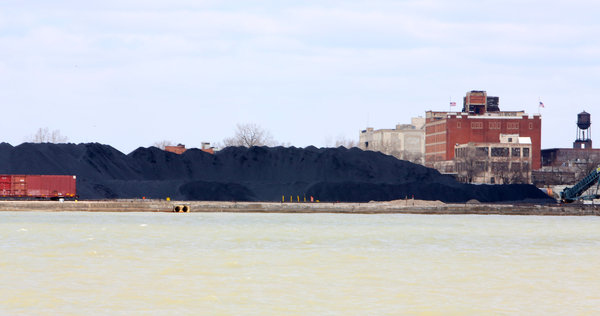
A recent article in the New York Times highlights the difference between “oil,” or “owal” as we say in Texas, and the heavy crude oil mined from Canadian tar sands. A major waste product of that mining is coke.  The tarry substance mined in Canada goes through an initial refining process to separate the crude from tarlike bitumen, caled “coking.” The tarry solid left from the process is called coke. It can be burned, and is an essential ingredient in making steel. The coke created from Canadian tar sands has a high sulfur content. Some of the Canadian tar sands are now being coked in a refinery in Detroit owned by Marathon Petroleum, and the coke by-product is sold to Koch Carbon, owned by Charles and David Koch. (I’m not making this up.) The Koch brothers have recently been in the news for considering an offer to buy the Los Angeles Times and the Chicago Tribune. They are also famous for supporting conservative and libertarian political causes. 

Here is the picture from the NYT article showing the stockpile of coke along the Detroit River belonging to the Kochs:

PILE-articleLarge.jpg

The crude oil generated by the coking process is the oil that is supposed to go through the Keystone pipeline running from Canada to the Texas coast, if that pipeline ever gets regulatory approval. According to the NYT article, Canada has 79.8 million tons of coke stockpiled. Efforts are underway to export Canadian coke to China and Mexico as a fuel. California, which also produces heavy crude that has to be coked, exports about 128,000 barrels of coke per day, mostly to China. The EPA does not permit it to be burned in the US. The Oxbow Corporation, owned by William I. Koch (a brother of David and Charles), is one of the world’s larges dealers in petroleum coke, selling about 11 million tons a year.

Published on:

The Texas Supreme Court has recently refused to hear Friddle v. Fisher, 378 S.W.3d 475 (Tex.App.-Texarkana 2012). The court of appeals’ opinion has an interesting discussion of the duties of a mineral owner to owners of non-participating royalty interests burdening the mineral estate and of the application of the discovery rule to claims that such duties were breached.

These are the facts of the case:  In 1949, M.L. Friddle conveyed 84.7 acres in Hopkins County to Barney Martin, reserving 1/4 of the royalty. The reserved royalty interest later came to be owned by M.L. Friddle’s son Marvin.  In 1995, Barney Martin conveyed 1/4 of the royalty in the 84.7 acres to Mable Robinson, and 1/4 of the royalty to Helen Warde. The following day, Martin conveyed the land to Fred and Ruth Fisher.  Later, Marvin Friddle acquired from Mable Robinson and Helen Warde the royalty interests that were conveyed to them. So, at the time this controversy arose, the Fishers owned the land and minerals, subject to a NPRI owned by Marvin equal to 3/4 of the royalty.

In 1998, the Fishers signed an oil and gas lease on the 84.7 acres, reserving a 1/8 royalty. Valence Operating Company formed a pooled unit, the Ames-Antrim Gas Unit, and pooled the 84.7 acres into the unit. Valence drilled a well on the unit, but the well was not located on the 84.7 acres. Neither Valence nor the Fishers notified Marvin of the granting of the lease, the formation of the pooled unit, or the drilling of the well. Valence paid all of the royalty attributable to the 84.7 acres to the Fishers.

Published on:

A study written by J. David Hughes and published in February by the Post Carbon Institute claims that shale gas reserves are vastly overstated. “Drill Baby Drill – Can Unconventional Fuels Usher In a New Era of Energy Abundance?”  A companion article by Deborah Rogers claims that the shale “frenzy” is a Wall-Street-created bubble, that “U.S. shale gas and shale oil reserves have been overestimated by a minimum of 100% and by as much as 400-500% by operators according to actual well production data filed in various states,” and that “shale oil wells are following the same steep decline rates and poor recovery efficiency observed in shale gas wells.” “Shale and Wall Street: Was the Decline in Natural Gas Prices Orchestrated?” Both are published on a website called shalebubble.org.  These nay-sayers are continuing a tradition that has followed the oil and gas industry for decades – the debate between the peak-oil advocates and those who believe we will never run out of fossil fuels.

David Hughes’ study is worth reading. He studied more than 60,000 shale wells in the US and their rates of decline, costs and reserves. Hughes concludes that more than 1,542 wells will have to be drilled each year in the Bakken and Eagle Ford plays just to maintain current production, at a cost of $14 billion per year. He estimates that it will take $42 billion and more than 7,000 wells per year to maintain current levels of production of shale gas, whereas the value of the gas produced in 2012 was only $32.5 billion. Some examples from Hughes’ study:

On overly optimistic predictions by the Energy Information Administration:

Published on:

The pipeline industry bill intended to “fix” the issues raised by Texas Rice Land Partners v. Denbury Pipeline, appears to be dead in the Texas legislature. The issue: requiring pipelines that assert the power of eminent domain to prove that they qualify as common carriers. The Texas Supreme Court held in Denbury that simply filing a form with the Texas Railroad Commission would not suffice; the pipeline has to show that it will actually use the pipeline to transport oil or gas for hire. This requirement could substantially slow the condemnation process, requiring pipelines to prove their common-carrier status each time they sue to condemn a right-of-way.

The solution proposed by the pipelines: have one hearing, at the Texas Railroad Commission, to establish that a proposed new line will in fact qualify for common-carrier status. That determination will then be binding on all landowners whose property will be crossed by the pipeline. Those landowners would be given the opportunity to participate in the hearings; notice of the hearings would be given by publication in local newspapers. The Texas Farm Bureau, the forestry industry, and other landowner groups opposed the bill. Most major oil and gas asociations favored the bill.

The bill, HB 2748, was defeated Friday on a procedural point of order raised by Democrats that moved it back to committee. Rural Republican representatives were faced with a difficult decision whether to support the bill, in light of opposition by rural landowners. Time is running out before the end of the session and it may be difficult to revive the bill.

Published on:

A recent editorial in the Houston Chronicle makes a good point: we should no longer think of “oil and gas” together. Their paths have diverged, at least in the US.

The prices of oil and gas used to be roughly equivalent, based on their energy value – their Btu content. But since the shale revolution in the US, this is no longer the case. Today, gas is much cheaper than oil on an energy-equivalent basis. Today, most exploration companies have moved from gas shale plays to oil shale plays, chasing the higher oil price. But gas prices have recently risen, and wells are still being drilled profitably in the Marcellus. If gas returns to $5-6/mcf, shale gas plays will return, and gas will still be much cheaper than oil.

Second, gas is a clean-buring fuel, unlike oil or coal. US emissions of greenhouse gases have declined substantially since utilities have gradually switched from coal to gas. Vehicles powered by gas have much lower emissions than those fueled by gasoline. Gas is touted as a “bridge fuel” in the transition from hydrocarbon to renewable sources of energy, because of its lighter environmental footprint.

Published on:

Information below passed on to me by a client, from a friend of a friend:


Following are charts and photos of a tour of Cline Shale exploration and operations yesterday afternoon. I remember the boom in the 50s and the late 70s. Those are minimal compared to the massive and very expensive boom taking place right now. I never imagined anything like this.

For instance, there are no small operators involved. Everyone leasing, building, drilling and operating has to be a major with very deep pockets. The road you will see in the first photo cost over $1 million to build. The wells are hitting 9,000 feet in this area and much deeper in other places. Each hydraulic fracturing operation (fracking) uses more than 5 million gallons of water. In just this area, railroad sidings have been built in Miles, San Angelo and Barnhart to unload sand and load oil. The railroad trains in San Angelo used to consist of a few dozen cars a week and now consist of 500 cars a day. And, really, this is just getting started.

Published on:

The drought in Texas, along with improved recyclying technology, has driven efforts to increase recycling of water used in hydraulic fracturing of wells. According to one estimate, the fracing of wells in 2011 consumed on the order of 135 billion gallons of water – about 0.3 percent of total U.S. freswater consumption. (Golf courses in the U.S. consume about 0.5 percent of all freswater used in the country.) But if you own land in the Eagle Ford field, those numbers don’t mean much. Water use in some counties is lowering the water table in the Carrizo-Wilcox aquifer, the principal source of frac water for the Eagle Ford, causing some existing wells to dry up. In West Texas, the lack of available groundwater has forced companies to look at recyclying their frac water to extend the useful life of the water they can find for fracing.

Two bills now pending in the Texas legislature – House Bills 3537 and 2992 – would require the Texas Railroad Commission to develp rules to require rthe recycling and reuse of frac water returned from wells. The Commission has recently adopted rules to make it easier for operators to recycle water. And another bill, House Bill 379, would impose a 1-cent-per-barrel fee on wastewater disposed of in commercial injection wells.

Devon Energy, a leader in recycling of frac water in the Barnett Shale, testified to Texas lawmakers that recycling is 50 to 75 percent more expensive than sending frac water to injection wells. There are now about 50,000 injection wells in Texas, and the number is growing rapidly. Recyling is much more common in the Marcellus, where injection wells are not available and water must be hauled long distances for disposal.

Published on:

Range Resources

Range Resources’ battle with the Lipskys and Alisa Rich continues, now in a confusing appeal of the trial court’s order denying the Lipskys’ and Rich’s motion to throw out Range’s counterclaim under the Texas law prohibiting so-called Strategic Lawsuits Against Public Participation, or SLAPPs.  http://www.star-telegram.com/2013/04/02/4745433/appeals-judges-return-range-suit.html

Earthquakes and Disposal Wells

Contact Information