Articles Posted in The Oil and Gas Lease

Published on:

Over the last 100 years courts have developed a body of case law in disputes between lessors and lessees of oil and gas leases. Courts have held that certain provisions are “implied” in the contracts, even though there is no language in the lease to support those provisions. The rationale behind these implied provisions goes back to cases interpreting hard mineral leases, and back to the cradle of the oil industry, Pennsylvania. The idea behind these implied provisions is that they are necessary for both parties to get the benefit of their bargain and to make the lease work as intended. Because the lessee has control over what operations are conducted under the lease, most of these implied provisions are intended to benefit the lessor, who generally has less bargaining power in negotiation of the lease and no say in whether and how the lease is developed.

An example: oil and gas leases generally provide that the lease will remain in effect for the primary term and for as long thereafter as oil or gas is produced from the leased premises. Courts have implied a requirement that, for the lease to remain in effect, the production must be in “paying quantities.” The production must be sufficient for the lessee to realize a profit over operating costs.

Another example: what if the well on the lease temporarily ceases production at some point after the end of the primary term. Does the lease terminate even if the well can be repaired and restored to production? Courts developed the implied provision that a “temporary” cessation of production will not cause the lease to terminate, as long as the lessee acts with reasonable diligence to restore production.

Published on:

The only three essential terms of an oil and gas lease are the granting clause, including a description of the property, the habendum clause, which defines the term of the lease, and the royalty clause. The following would be a valid, enforceable lease:

John Doe hereby leases to Gusher Oil Company the oil and gas in and under Section 5, Block 4, T&N RR Co. Survey, Jones County, Texas, for the purpose of exploring for and producing oil and gas. This grant shall be for a term of three years and as long thereafter as oil or gas is produced from the property. John Doe reserves a royalty of 1/4th of all oil and gas produced and saved.

Dated ___________________, 2014

Published on:

An essential element of any oil and gas lease is a description of the land to be covered by the lease. The test for a legal description is that it must contain, or make reference to recorded documents that contain, a description of the land of sufficient specificity that a surveyor could locate the property on the ground with reasonable certainty.

The lease itself can contain a metes and bounds description from a survey, or (more commonly) it can refer to an earlier recorded document that contains a metes and bounds description of the property. Sometimes descriptions have to be cobbled together from two or more other descriptions. For example: “All of that certain 100 acres of land described in deed from John Doe to Robert Smith recorded at Volume 99, page 99 of the deed records of Karnes County, Texas, save and except 10 acres of land described in deed from Robert Smith to Mary Jones recorded at Volume 100, page 100 of the deed records of Karnes County, Texas.”

There are other ways to adequately describe a tract. The test is whether the surveyor can use the description to locate the property.

Published on:

In Texas, an oil and gas lease grants to the lessee the fee mineral estate in the leased premises for the term of the lease. The lease provides for an initial term during which the lessee need do nothing in order to keep the lease in effect — called the “primary term.” Thereafter, the lease terminates unless the lessee is producing oil or gas or conducting operations in an effort to discover and produce oil or gas. If the lease remains in effect beyond the primary term, the remaining time the lease is in effect is called the “secondary term.” A typical lease will provide that

“This lease shall remain in effect for a term of three (3) years (the primary term) and as long thereafter as oil or gas is produced from the leased premises or operations, as provided herein, are being conducted on the leased premises.”

The primary term can be one month or ten years or more. Today, most leases provide for a three-year primary term. If no production or operations take place during the primary term, the lease terminates automatically and the mineral estate reverts to the lessor.

Published on:

I was recently reminded of a series of blog posts I did more than 10 years ago about the oil and gas lease. A law student who had come across one of my posts contacted me, telling me that she was the great-granddaughter off J.A. Heydrick of Oil City, Pennsylvania, who I identified in my post as the author of the first oil and gas lease form, published in 1880.

So, I have decided to republish my blog series on the oil and gas lease. Here is Part I.

The oil and gas lease is the foundational document on which the oil and gas industry in the US is based. Its form and provisions have been modified and shaped over the years to respond to changing industry practices and developments in the law, but its essential form has remained unchanged since the latter half of the 19th century. It is one of the most commonly used and successful legal documents in US commerce.

Published on:

Last March the El Paso Court of Appeals decided Cimarex Energy v. Anadarko Petroleum, No. 08-16-00353-CV.  The facts are these:

Cimarex leased a 1/6th interest in 440 acres in Ward County. Anadarko leased the remaining 5/6ths.  Cimarex asked Anadarko to let Cimarex participate in wells on the leases under a joint operating agreement, but Anadarko refused. Anadarko drilled two wells, carrying Cimarex as a non-consenting co-tenant. Cimarex sued for an accounting. The parties settled, Anadarko agreeing to an accounting and to pay Cimarex its share of net profits from the wells. Cimarex paid its royalty owner for its share of production “according to the terms of its lease, dating back to the date of first production.”

But at the end of the primary term of the Cimarex lease – December 21, 2014 – Anadarko stopped paying Cimarex, claiming its lease had expired. Anadarko took a new lease from Cimarex’s lessor. Cimarex sued Anadarko for breach of the settlement agreement. The trial court held that Cimarex’s lease had expired and dismissed its suit. On appeal, the Court of Appeals affirmed. Cimarex has now filed a petition for review in the Supreme Court.

Published on:

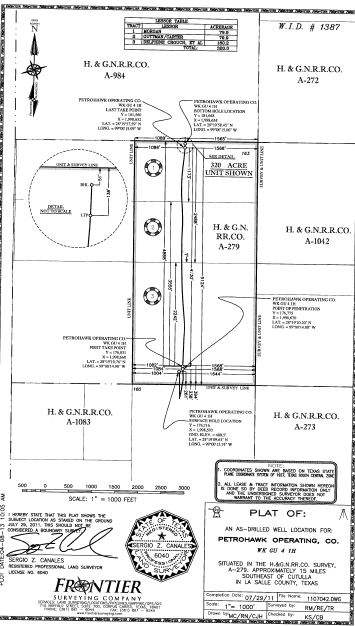
The San Antonio Court of Appeals handed down its opinion last week in Strickhausen v. Petrohawk Operating Company, No. 04-18-00636-CV.  The issue: Did Ms. Strickhausen ratify a pooled unit not authorized by her lease, or is she estopped from contesting the validity of the unit, because she accepted royalty checks calculated on her unit interest in production? The trial court held that she did; the Court of Appeals reversed and remanded, holding that there were issues of fact as to whether she intended to ratify or was estopped.

The issues relate to Petrohawk’s WK Unit 4 1H Well in La Salle County:

WK-Unit-4Ms. Strickhausen owns a 1/2 mineral interest in Tract 3 shown above. Her lease prohibits pooling without her consent. Without obtaining her consent, Petrohawk filed a pooled unit designation including her lease and drilled the well. It then asked Ms. Strickhausen to ratify the unit. Settlement negotiations were unsuccessful. Petrohawk sent Ms. Strickhusen checks for her share of unit production, which she cashed, but her attorney continued to tell Petrohawk that she objected to the pooled unit.

Published on:

Like most subjects, understanding oil and gas law is often a matter of knowing the terminology – WI, RI, ORRI, NPRI. These terms are often used in a confusing way and the definitions sometimes overlap. So I’m going to try to clear things up.

It all starts with the mineral estate. In Texas, the mineral estate can be separated (“severed”) from the surface estate. This can be done either by a conveyance or a reservation. I grant Blackacre to John Doe, reserving the mineral estate; or I convey the mineral estate in Blackacre to John Doe.  The mineral estate is considered an ownership interest in land, just like the surface estate. It carries with it certain rights – the right to explore for and extract the minerals under the land. To make that right effective, the owner of the mineral estate must have the right to use the surface estate – to go on the land and drill wells. So the mineral estate is called the “dominant estate,” because the surface estate is subject to the rights of the owner of the mineral estate to use the land to extract minerals.

The mineral owner may grant an oil and gas lease to an exploration company to drill wells on the land. In Texas, an oil and gas lease is a conveyance to the lessee of the mineral estate for the term of the lease, reserving a royalty interest.  An oil and gas lease severs the mineral estate into two interests – the lessee’s interest, often called the “working interest,” and the reserved royalty interest. When the lease expires, those two estates merge back together into the mineral estate.

Published on:

TexasBarToday_TopTen_Badge_SmallThe Texas Supreme Court recently refused to consider the case of Devon Energy Production Company v. Apache Corporation, decided by the Eastland Court of Appeals – 550 S.W.3d 259. The case presents issues that, remarkably, have not previously been considered by a Texas appellate court.

Norma Jean Hester leased her one-third mineral interest in lands in Glasscock County to Apache, reserving a 1/4th royalty. The other mineral owners in the land (the Lessor Plaintiffs) leased their two-thirds mineral interest to Devon, reserving a 1/4th royalty.  Apache and Devon were unable to agree on terms for a joint operating agreement to develop the property, and Apache drilled seven producing wells on the land without Devon’s participation. Devon became what is commonly called a “non-consenting co-tenant.”  Devon became entitled to two-thirds of the net revenue from each well after Apache had recovered the costs of drilling and production (“payout”).  But Devon did not pay its Lessor Plaintiffs their royalty on production, claiming that Apache owed the royalties to the Lessor Plaintiffs. The Lessor Plaintiffs sued Devon and Apache for their royalties.

The trial court ruled that Apache owed no royalty payments to the Lessor Plaintiffs, and that Devon owed the Lessor Plaintiffs royalties, but only on revenues received by Devon after the wells had paid out.  The Lessor Plaintiffs then settled their claims against Devon, and Devon appealed. Continue reading →

Published on:

In Devon v. Apache, No. 11-16-00105-CV, the Eleventh Court of Appeals sheds some light on a vexing problem that remarkably has never been addressed by a Texas court.  To understand the problem, consider the facts in Devon v. Apache:

Norma Jean Hester leased her one-third mineral interest in land in Glasscock County to Apache, reserving a one-fourth royalty. The remaining mineral owners leased to Devon, also reserving a one-fourth royalty. Apache and Devon were not able to reach agreement on joint development of the property, and Apache drilled seven wells on the property without Devon’s participation. Under Texas law, Devon and Apache were co-tenants, and Apache is obligated to account to Devon for 2/3rds of the net profits from the wells, which Apache did. But Apache refused to pay Devon’s royalty owners. Continue reading →

Contact Information