Recently in Eagle Ford Shale Category

August 30, 2010

Industry News

EIA Forecast of Energy Prices

   The Energy Information Administration has forecasted that oil and natural gas prices will rise slightly through 2011. It predicts oil to average $84/bbl in 2001, and that the Henry Hub spot price for natural gas will average $4.98/MMBtu in 2001, an incurease of 6% from 2010.  EIA forecasts that US natural gas consumption will increase 3.8% from 2009 levels in 2010, then remain flat in 2011. It predicts total natural gas production to increase by 1.1 Bcf/d in 2010, an increase of 1.9%.

Devon Energy CEO Says Low Prices Will Mean Lower Rig Counts

  John Richels, President of Devon Energy, said that the natural gas rig count will begin to fall by mid-2011 if prices continue to remain at $5/MMBtu or less.  Richels said in a speech at the Houston Petroleum Club that drilling has remained high to hold leases bought in 2007 and 2008, and once that acreage is drilled enough to prevent lease expirations there will be little reason to continue drilling unless prices rise to the $6 to $7 range. 

http://www.platts.com/RSSFeedDetailedNews/RSSFeed/HeadlineNews/NaturalGas/6297353/

Rig Count

  The US Baker Hughes rig count as of August 20 was 1,651 total rigs -- 655 oil and 985 gas. This is up 666 from a year ago, or 68%. The Texas rig count was 716, up 344 from last year's count of 372, or 92%. The state with the next highest rig count was Louisiana, with 184 rigs.

EOG Reports Results in Oil Window of Barnett Shale

   EOG Resources reports that it has had significant success with wells in the Eastern Barnett 'Combo Play.' EOG says it has about 150,000 net acres in the liquids-rich portion of the Barnett. It says its Settle #1H has an EUR of 260,000 bbls of oil, 412,000 bbls of natural gas liquids and 3 Bcf of natural gas based on the first three months of production. Its Richardson 3H in Cooke County came on production at 325 bbls/d, and in Montague County, its King 1H had initial rates of 344/bbls/d, while its Olden B-1H had initial rates of 323 bbls/d and 1/7 MMcf/d, and its Alamo B-6H came on at 500 bbls/d.

http://www.ogj.com/index/article-display/7019703212/articles/oil-gas-journal/drilling-production-2/2010/08/eastern-barnett_combo.html

EPA Postpones NY Meeting on Fracturing Study

  The Environmental Protection Agency has been holding public hearings across the country on its study of hydraulic fracturing, mandated by Congress. It was forced to postpone a hearing scheduled to take place on August 12 in the Syracuse convention center. Originally that hearing was to take place at Brighamton University, but was moved after Binghamton said it wanted $40,000 to cover costs of an overflow crowd expected to exceed 8,000 people. No new date has been set. The agency originally scheduled three four-hour sessions for the New York meeting in anticipation of the larger crowds.

http://yosemite.epa.gov/opa/admpress.nsf/0/EA536794EF7EFDFB8525777B00608470

Range Resources Plublishes Contents of Frac Fluids

  Range Resourcss has voluntarily published the chemicals used in its frac fluids in wells drilled in Pennsylvania. It has posted the information for three Marcellus wells on its website, and will publish the information for additional wells as they are drilled and completed.

Rosetta Resources Announces Results of Eagle Ford Shale Drilling

Rosetta Resources provided details of the results of its drilling in the Eagle Ford Shale in northern Webb County. In its Gates Ranch area, Rosetta has drilled 14 horizontal wells, and those wells have averaged 320 Bbl/d of condensate, 500 Bbl/d of natural gas liquids and 3.1 MMcf/d of gas for their first seven days of production. It said about 80% of the value from these wells is comprised of liquids. Wells costs are averaging $6.5-$7.5 million per well, with 13-15 frac stages per well. Rosetta expects to drill 30-35 Eagle Ford wells in 2010.

http://www.marketwatch.com/story/rosetta-resources-inc-announces-second-quarter-2010-results-provides-capital-program-update-and-announces-additional-asset-sales-2010-08-09?reflink=MW_news_stmp

EOG Announces Eagle Ford Plans

EOG Resources has announced that it plans to drill 111 Eagle Ford wells this year and 245 Eagle Ford wells in 2011. EOG has about 505,0000 acres mostly in the oil window of the play. EOG said its recent Eagle Ford wells have had initial completion rates of 1,033, 1,022 and 625 Bbls/d of oil and condensate, and that its first two wells in Wilson County came on at rates of 707 and 836 Bbls/d.

http://www.ogj.com/index/article-display/4882105480/articles/oil-gas-journal/exploration-development-2/2010/08/eog-to_quicken_its.html

Bookmark and Share
August 4, 2010

Rig Counts In Major Texas Shale Plays

RigData has compiled the numbers of active drilling rigs by county for each of the major shale plays in Texas: Barnett, Haynesville and Eagle Ford. These serve as a good measure of the degree of activity in each of the counties within these plays.

The Barnett Shale rig count  shows a total of 81 rigs in July. The rig count has held steady around 80 for the last several months. Activity is concentrated in the core area, Tarrant and Johnson Counties.

The Haynesville Shale rig count  has a total of 184 rigs working in both Texas and Louisiana, with 56 of those rigs in Texas - 12 in San Augustine County, 11 in Harrison County, 10 in Shelby County, and 9 each in Nacogdoches and Panola Counties. This count also has remained steady at around 180 rigs over the last several months.

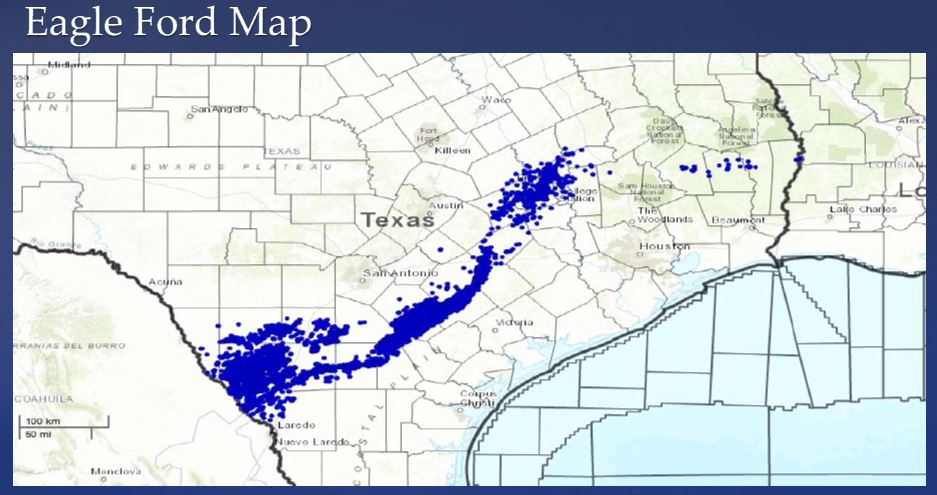
The Eagle Ford in South Texas has 84 rigs running , up from 49 rigs in April, including 22 rigs in Webb County, 12 in La Salle County, and 10 deach in Dimmit and De Witt Counties. Operators are clearly moving rigs into the oil-rich portions of the Eagle Ford, to take advantage of the oil and liquid-rich portions of that play in light of low gas prices.

Bookmark and Share
July 6, 2010

EOG Proposes New Temporary Field Rules for Oil Wells in Eagle Ford Shale

EOG Resources has filed an application for designation of two new fields and for temporary field rules for oil wells in seven counties in South Texas (Eagle Ford proposed rules.pdf). Unlike its previous application, which sought to consolidate numerous Eagle Ford fields in Railroad Commission of Texas Districts 1, 2 and 4 and provide for temporary field rules for oil and gas, the new application seeks rules oil well rules only, for seven counties -- DeWitt, Karnes, Gonzales, Wilson, Atascosa, LaSalle and McMullen. EOG asks for expansion of the existing Eagleville (Eagle Ford) Field, renamed the Eagleville (Eagle Ford -2) Field for Karnes and DeWitt Counties, and a new Eagleville (Eagle Ford -2) Field for Gonzales, Wilson, Atascosa, LaSalle and McMullen Counties.

The proposed rules would provide for a minimum 330 feet from lease line spacing, no between-well spacing, and a minimum of 100 feet from lease line to the first and last take points in a horizontal well, a "box" rule, and a special rule for off-lease penetration of the producing formation.

The standard proration unit size for oil wells would be 80 acres, plus additional acreage for horizontal wells as allowed by RRC Rule 86. Under the proposed rules, an operator would be allowed to assign up to 360 acres to a horizontal well with a 5,000-foot lateral.

Bookmark and Share
June 25, 2010

EOG Withdraws Application for Temporary Field Rules in Eagle Ford Shale

At the hearing today before the Texas Railroad Commission for consideration of EOG Resources' application for temporary field rules for a new field consolidating 27 existing fields in the Eagle Ford Shale in South Texas, the applicant EOG Resouces announced that it was withdrawing its application. (See my previous post on this application here.) EOG's lawyer said that the application was filed at the suggestion of Railroad Commission staff in order to have uniform rules for all wells drilled in the Eagle Ford, but because of the number of parties who had appeared in the hearing in opposition to the application, EOG would withdraw the application. He said that EOG plans to file a new application for temporary field rules for the Eagle Ford in eight counties where EOG has acreage: Gonzales, Wilson, Karnes, Atascosa, McMullen, La Salle, DeWitt, and Frio Counties. He said that the rules EOG would propose would apply to oil wells only, as EOG's acreage is in the oil window of the play. Other operators in the gas portion of the play are also expected to file additional applications for temporary field rules for gas wells.
Bookmark and Share
June 10, 2010

EOG Resources Proposes Temporary Consolidated Field Rules for Eagle Ford Shale

EOG Resources has filed an application with the Texas Railroad Commission proposing the adoption of temporary field rules for wells drilled in the Eagle Ford Shale in South Texas that could have a significant impact on thousands of oil and gas leases in the field. The application proposes to consolidate 27 designated fields that produce from the Eagle Ford Shale formation, and the proposed rules will replace any field rules previously adopted for those fields. The consolidated rules would apply to Eagle Ford Shale wells drilled in Railroad Commission of Texas Districts 1, 2 and 4. A copy of the notice of the Railroad Commission hearing for the adoption of the proposed rules may be found here:  eagle ford field rules.pdf. The hearing is scheduled for June 25, 2010, at 9 am in the William B. Travis Sate Office Building, 1701 Congress Avenue, Austin. Persons wishing to participate in the hearing must file a notice of intent to appear at least five working days in advance of the hearing date and serve a copy of the notice on the applicant and any other parties of record. More information can be obtained by calling the Office of General Counsel of the Railroad Commission at 512-463-6848.

Field rules are adopted by the Railroad Commission to govern the spacing of wells in a field. They specify how far wells must be from each other, how far wells must be from the nearest lease line, and how much acreage must be assigned to a well in order to obtain a permit to drill a well. The acreage assigned to a proposed well is known as a "proration unit." Well spacing and density rules were developed by the Commission after it was given jurisdiction over oil and gas operations in Texas in the early days of the oil industry, principally because of unregulated drilling in the East Texas Field. Because of unregulated drilling in that field, wells were being drilled that were not necessary for the efficient development of the field, and oil prices plummeted. The Commission was also given authority to "prorate" production from a field -- that is, to limit production, and to allocate or "prorate" the specified limit of production from a field among the wells in a field. The stated purposes of spacing and density rules are to avoid waste and protect the correlative rights of producers in the field. Theoretically, field rules should designate a size for proration units that approximates the amount of acreage in the field that can be efficiently drained by a single well.

The field rules proposed by EOG would provide:

Continue reading "EOG Resources Proposes Temporary Consolidated Field Rules for Eagle Ford Shale" »

Bookmark and Share
May 7, 2010

News of "Super Extended Laterals" in Woodford Shale, and ConocoPhillips' First Well in Eagle Ford Shale

Newfield Exploration has reported that it is drilling horizontal wells with "super extended laterals" in the Woodford Shale in Oklahoma -- wells with laterals exceeding 5,000 feet. Newfield has so far drilled 14 super-extended lateral wells, with an average length of 9,000 feet. Those wells had an average gross initial production rate of approximately 9 MMcfe/day.

ConocoPhillips reported that it has completed the drilling of four horizontal wells in the Eagle Ford shale play, in its "liquids-rich" core. The first of these wells was put on production in March and flowed at an initial rate of 3.8 mmcf/day and 1,200 barrels/day of condensate.

All of the new shale gas production continues to put downward pressure on gas prices. Natural gas futures for June delivery fell 36.8 cents, or 8.5 percent on Thursday, April 29 on NYMEX. So far this year, natural gas futures have fallen 29 percent. The Energy Information Administration reported that the supply of gas in storage increased  by 83 Bcf for the week ended April 30. Gas in storage is 315 Bcf above the 5-year average.

natural-gas-in-storage.gif

Bookmark and Share