Published on:

Last week, the Fourth Court of Appeals in San Antonio issued its opinion in Chesapeake v. Hyder.pdf, on gas royalties owed to the Hyder family for production in Johnson and Tarrant Counties, in the Barnett Shale. The court upheld a judgment against Chesapeake for more than a million dollars, including $250,000 in attorneys’ fees. The result is not surprising considering the language in the lease, but the case is interesting because it reveals Chesapeake’s structure for marketing of gas in the Barnett Shale, obviously designed to reduce its gas royalty obligations.

The principal issue on appeal was whether Chesapeake could reduce the Hyders’ royalty by the amount of transportation costs paid by Chesapeake to unrelated pipeline companies. The trial court and court of appeals held that it could not. As I have written before (here, here and here), deductibility of post-production costs is a continuing issue for gas royalty payments in Texas. Prior Supreme Court cases have held that such costs are deductible under most standard gas royalty clauses.

The Hyders’ royalty clause was not a standard lessee-form lease. It provided:

Published on:

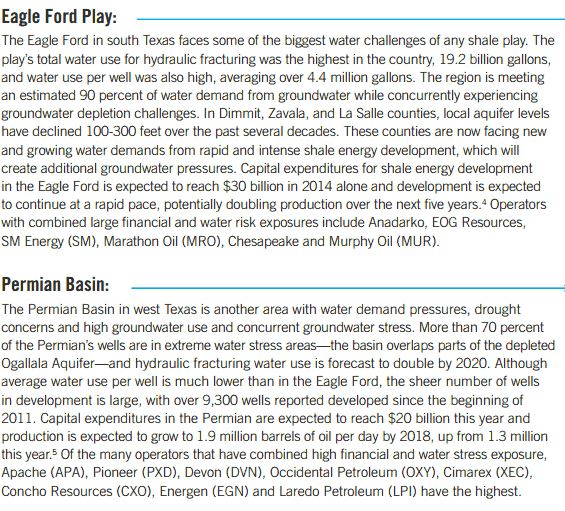
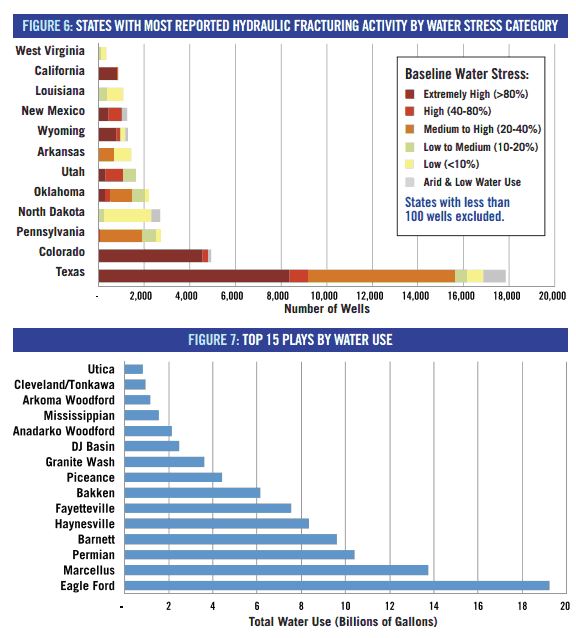
Ceres, a nonprofit focusing on climate change, water scarcity and sustainability, has issued a report, Hydraulic Fracturing & Water Stress: Water Demand by the Numbers, a Shareholder, Lender & Operator Guide to Water Sourcing.  Here are some excerpts:

Ceres.JPG

________________________________________________________________________________

ceres2.JPG

________________________________________________________________________________________

Published on:

As drilling activity in the onshore US continues to grow, more and more attention is being paid to the environmental effects of exploration and production.  Media stories abound about groundwater contamination, the demand for fresh water from hydraulic fracturing, increased air emissions from exploration and production, controversy over pipeline condemnation and construction, earthquakes linked to wastewater injection, increased traffic and accidents, and effects on endangered species. Recent examples:

Air Emissions

This week The Center for Public Integrity, InsideClimate News and The Weather Channel released a report, Big Oil, Bad Air, on the effects of drilling in the Eagle Ford Shale on air quality in South Texas.  The report is highly critical of the lack of regulation by the Texas Commission of Environmental Quality (TCEQ) of emissions from oil and gas exploration and production operations in that region. Criticism of the report has already hit the media. Here is an industry response to the report from Energy in Depth, a website sponsored by industry. The TCEQ says it plans to conduct video surveillance of air quality over the region this summer

Published on:

In the later chapters of The Quest, Daniel Yergin summarizes the history of the internal combustion engine.  He begins by recounting a meeting of Henry Ford and Thomas Edison at a convention in August 1896, at which they sat together. Ford had just built his first gasoline-powered “quadricycle.”  He sketched out his design to Edison. Edison told him that the problem with electric-powered vehicles is that they “must keep near a power station.”  Edison told Ford to stick with the internal combustion engine.

The internal combustion engine was invented by Nikolaus Otto. His “Otto cycle” engine, developed in 1876, is still recognizable in our engines today: valves, a crankshaft, spark plugs, and a single cylinder.  Otto teamed with Karl Benz to produce automobiles, and Gottlieb Daimler was in close competition.  (In the twentieth century, the two companies merged, though Benz and Daimler never met each other.) By the 1890’s Daimler was distributing his cars in America.

Germany competed with France — with the French engineers Armand Peugeot and Louis Renault — for supremacy in the development of the automobile.  Britain was initially left behind because its railway industry, fearing competition, got Parliament to pass the Red Flag Acts that limited “road locomotives” to four miles an hour in the country and two miles an hour in cities — as well as requiring a man carrying a red flag to walk in front of road vehicles hauling multiple wagons.

Published on:

Julia Trigg-Crawford, a landowner in Lamar County, has asked the Texas Supreme Court to hear her case arguing that TransCanada has no right to condemn her property for the Keystone XL Pipeline.  The Crawford Family Farm Partnership v. TransCanada Keystone Pipeline, L.P., No. 13-0866. Although other segments of the pipeline await federal approval, the segment from Oklahoma across Texas has now been completed and is in operation.  Crawford lost her case in the trial court and the Texarkana Court of Appeals, 409 S.W.3d 908, and has asked the Supreme Court to review the case. The Supreme Court asked TransCanada to reply to Crawford’s petition, and Texarkana filed its reply on February 6. 

Crawford’s argument is that Texas law does not grant eminent domain powers to interstate pipelines.  TransCanada argues that Crawford’s appeal presents the same issues as Rhinoceros Ventures Group, Inc. v. TransCanada Keystone Pipeline, L.P., 388 S.W.3d 305 (Tex. App.–Beaumont 2012, pet. denied), which the Supreme Court declined to review.

Crawford has become a symbol of opposition to the Keystone pipeline, drawing national attention to her cause.

Published on:

The New York Times reported recently that the number of mobile or “walking” drilling rigs in operation now exceeds the number of conventional rigs, by 650 to 500. “Pad drilling” — the drilling of multiple wells from a single pad site — has now become the norm in unconventional plays, and these walking rigs make drilling from a single pad site more economical and efficient. Moving a rig to a new location now takes a matter of hours instead of days. The new rigs cost up to $20 million. The increased effeciency of these rigs has actually reduced the rig count while increasing the number of wells drilled, and has caused the Energy Information Administration to develop a new rig-efficiency measure.  The combination of walking rigs and multi-well drillsites results in significant reductions in drilling costs. Continental Resources, the largest player in the Bakken, says it now can drill 14 wells from a single pad.

EIA’s new Drilling Productivity Report shows how the new technology has affected production in the major shale plays. Here is its graph for the Eagle Ford:

EIA Eagle Ford Well Efficiency.JPG

Here is an annual comparison for several shale plays:

Published on:

Recent news relating to oil and gas exploration and development in Texas:

Dune Sagebrush LizardGood article on efforts of industry and State regulators to avoid problems raised by possible listing of the Dune Sagebrush Lizard under the Endangered Species Act. Here is a map of the lizard’s habitat – right in the middle of the Permian Basin.

Earthquakes in the Oil Patch — Earthquakes in and around Azle, in the Barnett Shale, have caused quite a stir.  Here’s a good article from the San Antonio News. Everyone seems to agree that the quakes are caused by injection wells, except the Texas Railroad Commission, which until recently called the connection “hypothetical”. After one of the Commissioners, David Porter, faced angry homeowners at a town hall meeting in Azle, he called for the RRC to hire its own seismologist. Azle residents are planning a bus trip to Austin to attend the next RRC conference in protest.

Contact Information