Published on:

Earthquakes linked to oil and gas activity are in the news.  A recent study in Ohio linked a rash of small earthquakes to fracing of wells in the area. Earthquakes in Oklahoma have increased tenfold since 2009. A swarm of small earthquakes hit the Dallas-Fort Worth area recently. The US Geological Survey is raising its evaluation of earthquake hazard risk in Texas as a result. 

In Texas, the spate of small earthquakes is tentatively tied to injection wells rather than fracing of new wells. The theory is that the injected water lubricates lithologic layers, allowing them to slip and causing quakes.

The Environmental Protection Agency estimates that there are 144,000 Class II injection wells in the US. The RRC has permitted more than 50,000 Class II injection wells in Texas since the 1930’s. These injection wells are used to dispose of water and waste produced from wells, both that from the fracing process and water produced with oil and gas in the production phase. Many oil wells produce hundreds of barrels of water for each barrel of oil produced. Without injection wells, the Texas oil and gas industry would screech to a halt.

Published on:

In a special section of the January 17 edition of The Economist, Edward Lucas gives a broad overview of the world energy outlook and the future for renewable energy. His is an optimistic forecast for cleaner, cheaper and more plentiful energy. His article can be found online here.

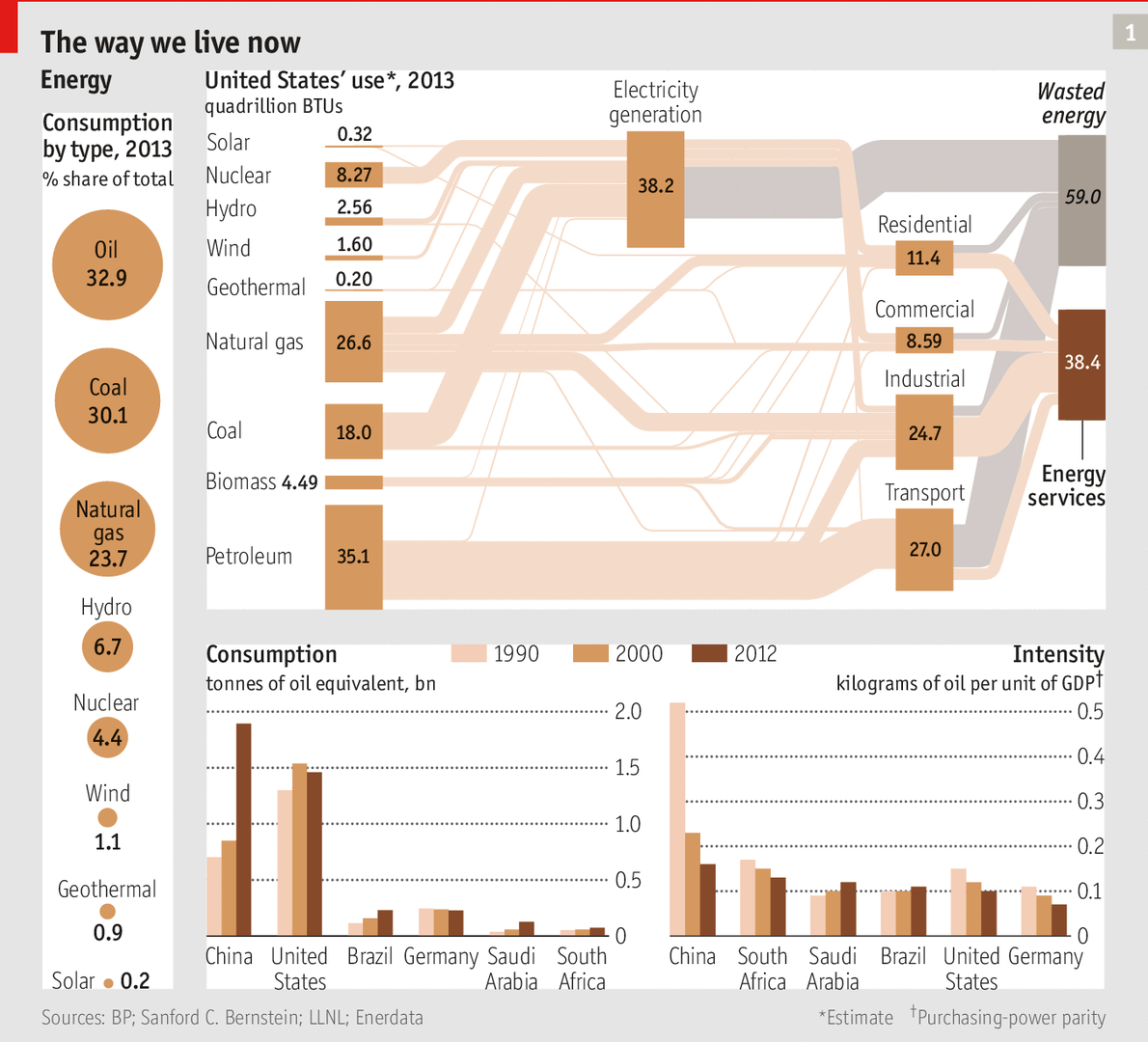
First, the article provides this view of current world energy production and consumption:

economist.pngThis picture doesn’t present a very optimistic view. Almost 60% of energy production is “wasted energy.” Oil still provides 33% of all energy consumed, while wind supplies only 1.1%, and solar only 0.2%. And the EIA projects that global demand for energy will increase by 37% in the next 25 years.

Published on:

Over the last 100 years courts have developed a body of case law in disputes between lessors and lessees of oil and gas leases. Courts have held that certain provisions are “implied” in the contracts, even though there is no language in the lease to support those provisions. The rationale behind these implied provisions goes back to cases interpreting hard mineral leases, and back to the cradle of the oil industry, Pennsylvania. The idea behind these implied provisions is that they are necessary for both parties to get the benefit of their bargain and to make the lease work as intended. Because the lessee has control over what operations are conducted under the lease, most of these implied provisions are intended to benefit the lessor, who generally has less bargaining power in negotiation of the lease and no say in whether and how the lease is developed.

An example: oil and gas leases generally provide that the lease will remain in effect for the primary term and for as long thereafter as oil or gas is produced from the leased premises. Courts have implied a requirement that, for the lease to remain in effect, the production must be in “paying quantities.” The production must be sufficient for the lessee to realize a profit over operating costs.

Another example: what if the well on the lease temporarily ceases production at some point after the end of the primary term. Does the lease terminate, even if the well can be repaired and restored to production? Courts developed the implied provision that a “temporary” cessation of production will not cause the lease to terminate, as long as the lessee acts with reasonable diligence to restore production.

Published on:

The Colorado Oil and Gas Conservation Commission now allows landowners with complaints against operators to file their complaint online. Go to http://cogcc.state.co.us/ and click on “Complaints” in the left-hand column.If you’re a surface owner with no mineral rights and you have objections to a proposed well location, you can also get the COGCC to inspect the site and consider your objections and require the operator to accommodate your concerns.

The online portal is very user-friendly and a real effort to make it easier for the public to participate in the process. The Texas Railroad Commission should take note.  The COGCC has also significantly increased its oversight staff, increased its collaboration with local governmental entities, sponsored studies on air and water impacts, and adopted policies on health and safety issues.

Published on:

A recent “swarm” of small quakes in Irving has caused a stir and ignited a series of articles about the relation between oil and gas activity and seismic events. The quakes in Irving were strong enough to knock some books off of shelves.

After residents of the town of Azle experienced a series of quakes in 2013, residents protested in Austin before the Texas Railroad Commission, and as a result the RRC hired its own seismologist to study the problem. Most scientists have linked quakes in Texas and Oklahoma to injection of large volumes of produced water. Recently one study in Ohio linked quakes there to recent fracking of wells in the area.

Most if not all of the actual studies of recent quake activity are being done by Southern Methodist University. It has studied the quakes around Azle, and a report of its study is expected soon. After the quakes in Irving, SMU is installing seismic monitors in that area.

Published on:

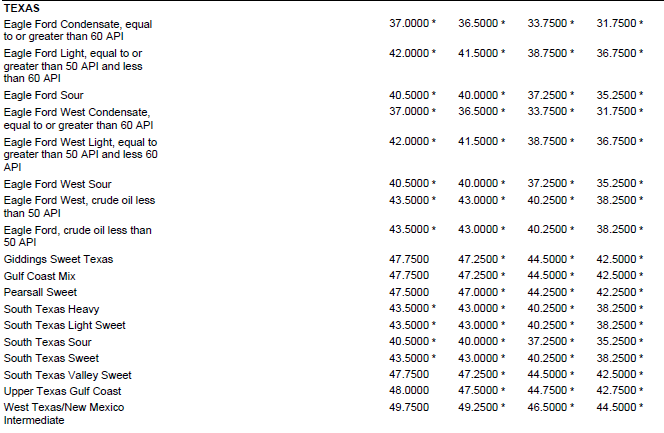
Here are Flint Hills postings for Texas for January 1, 2, 5 and 6:

download
Eagle Ford West Light Crude has dropped from $42/bbl on January 1 to $36.75/bbl yesterday. Amazing.

View all Flint Hills postings here:  http://www.fhr.com/refining/bulletins.aspx

Published on:

The only three essential terms of an oil and gas lease are the granting clause, including a description of the property, the habendum clause, which defines the term of the lease, and the royalty clause. The following would be a valid, enforceable lease:

John Doe hereby leases to Gusher Oil Company the oil and gas in and under Section 5, Block 4, T&N RR Co. Survey, Jones County, Texas, for the purpose of exploring for and producing oil and gas. This grant shall be for a term of three years and as long thereafter as oil or gas is produced from the property. John Doe reserves a royalty of 1/4th of all oil and gas produced and saved.

Dated ___________________, 2014

Published on:

As I have written, Chesapeake has asked the Texas Supreme Court to reverse the San Antonio Court of Appeals’ decision in Chesapeake v. Hyder. The court of appeals ruled that Chesapeake could not deduct post-production costs from the Hyders’ royalty.

The Texas Land & Mineral Owners’ Association and the National Association of Royalty Owners – Texas have filed an amicus brief in Hyder supporting the Hyders’ case. The brief can be viewed here. Final Amicus_Brief_Chesapeake_v__Hyder.pdf It was authored by my firm and by Raul Gonzalez, who was a member of the Texas Supreme Court when the court decided Heritage v. NationsBank, the case relied on by Chesapeake as authority for its deduction of post-production costs.

Published on:

An essential element of any oil and gas lease is a description of the land to be covered by the lease. The test for a legal description is that it must contain, or make reference to recorded documents that contain, a description of the land of sufficient specificity that a surveyor could locate the property on the ground with reasonable certainty.

The lease itself can contain a metes and bounds description from a survey, or (more commonly) it can refer to an earlier recorded document that contains a metes and bounds description of the property. Sometimes descriptions have to be cobbled together from two or more other descriptions. For example: “All of that certain 100 acres of land described in deed from John Doe to Robert Smith recorded at Volume 99, page 99 of the deed records of Karnes County, Texas, save and except 10 acres of land described in deed from Robert Smith to Mary Jones recorded at Volume 100, page 100 of the deed records of Karnes County, Texas.”

There are other ways to adequately describe a tract. The test is whether the surveyor can use the description to locate the property.

Contact Information