World’s Largest LNG-Powered Container Ship
From the Energy Information Administration:
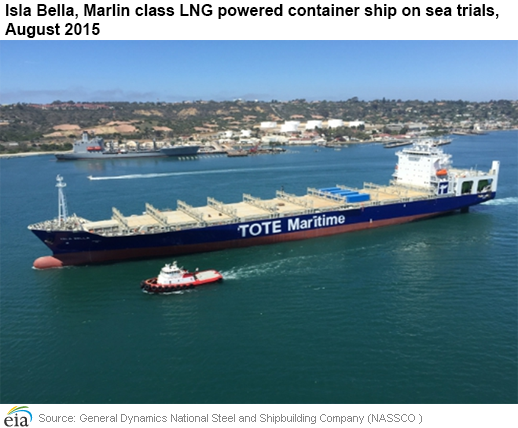
The General Dynamics shipyard in San Diego delivered the world’s first liquefied natural gas (LNG) powered containership to TOTE Maritime on October 16. The 764-foot long Isla Bella is the first of the Marlin class, a new class of container ship built in the United States, making it Jones Act-qualified for shipments between U.S. ports. The ship was built by the National Steel and Shipbuilding Company, a division of General Dynamics.
(Click to enlarge)
Delivered nearly two months ahead of schedule, the Isla Bella will operate out of Jacksonville, Florida, providing service to and from San Juan, Puerto Rico. The second ship of the class, the Perla del Caribe, will be delivered in early 2016 and will service the same trade route. These ships join a small group of LNG-powered ships, which currently number fewer than 100, excluding LNG tankers, according to data from DNV GL Maritime. They are the first in the largest category of vessels–container ships, numbering in the tens-of-thousands–to be built with dual-fuel propulsion intent on employing LNG as the primary fuel.
Eartquake Near Cushing Oklahoma
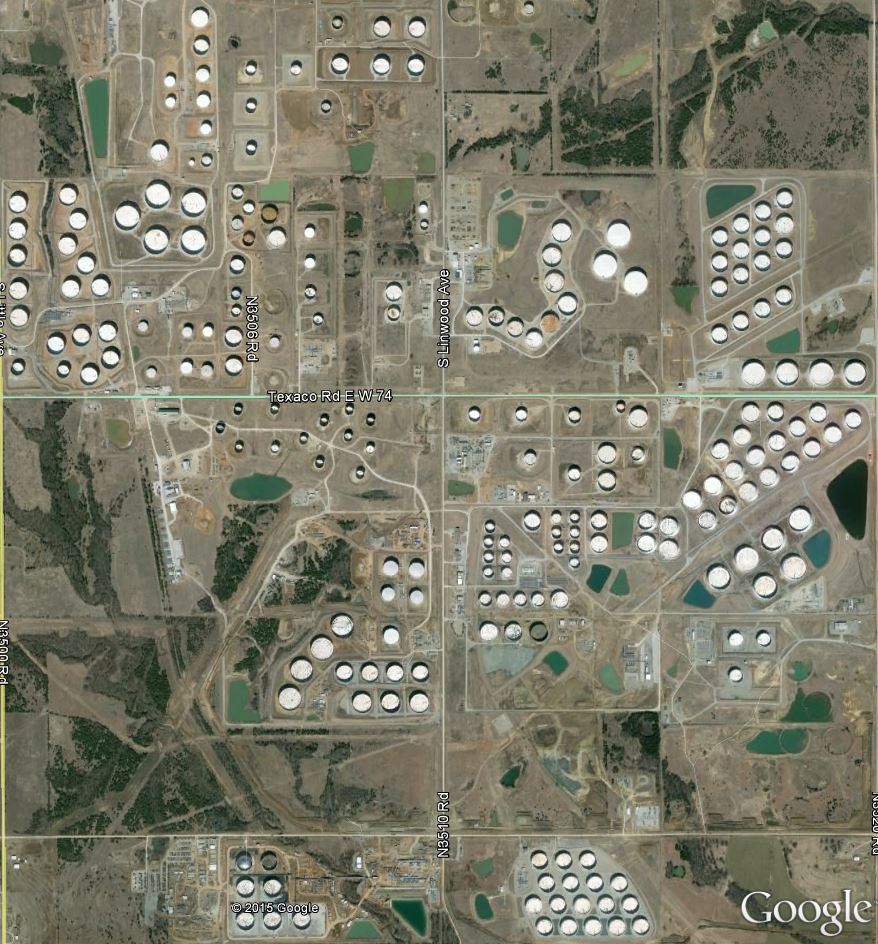
Recent earthquakes near Cushing, Oklahoma have caused a seismic shift in the state’s response to induced quakes in that state. The reason – Cushing is a major hub in the U.S. for storage and shipments of crude. Below is a snapshot of some of the giant storage tanks just outside the town (click to enlarge):

Some of these tanks are large enough to hold a Boeing 747. Cushing’s storage can hold more than 10 million barrels of oil; it is the largest commercial storage depot in the U.S.
A flurry of quakes have recently hit near Cushing. On October 10, a quake measuring 4.5 on the Richter scale hit about three miles from the town. Scientists have linked increased seismic activity in Oklahoma to increased waste water injection. 3.3 billion barrels of waste water were injected under Oklahoma from 2011 through 2013.
Amici Weigh In on Motion for Rehearing in Chesapeake v. Hyder
The Texas Supreme Court asked the Hyders to respond to Chesapeake’s motion for rehearing in Chesapeake v. Hyder, after the court’s recent 5-4 decision in favor of the Hyders. Several amicus briefs (“friend of the court” briefs by entities not parties to the case) were filed in support of Chesapeake’s motion for rehearing. Exploration companies are clearly unhappy with language in Chief Justice Hecht’s majority opinion and asking the court to modify its language. The amicus briefs made the San Antonio Business Journal’s “Eagle Ford Shale Insight” feature.
I’ve written about this case before, and our firm filed an amicus brief in the case before the court issued its opinions, on behalf of Texas Land & Mineral Owners’ Association and the National Association of Royalty Owners-Texas.
So far, on rehearing, the following parties have joined in amicus briefs criticizing the court’s majority opinion:
More on Retained Acreage Clauses
I recently wrote about two appellate opinions dealing with retained acreage clauses in oil and gas leases. A retained acreage clause requires the lessee to release acreage not assigned to a producing well at the end of the primary term, or at the end of a continuous drilling program conducted after the primary term. One commentator has said that the purpose of a retained acreage clause is to “replace the lessor’s need to utilize the implied covenant of reasonable development as the sole means to see that its acreage is fully developed.” Bruce M. Kramer, Oil and Gas Leases and Pooling: a Look Back and a Peek Ahead, 45 Tex. Tech L. Rev. 877, 881 (2013).
A retained acreage clause should be included in any oil and gas lease that covers a significant amount of acreage – more than 100-200 acres. Below is a retained acreage clause, from the TLMA lease form. TLMA is the Texas Land and Mineral Owners Association. I prepared the lease form, and TLMA provides it to all of its members:
Upon expiration of the Primary Term, or upon cessation of “Continuous Drilling Operations” (as hereinafter defined), whichever is later, this Lease shall terminate as to all the lands and depths then covered thereby except lands and depths then designated by Lessee, in accordance with the requirements of this Paragraph, to be within a “Production Unit” (as hereinafter defined) assigned to each well then producing in paying quantities on the Leased Premises or lands properly pooled therewith.
Oral Argument in Coyote Lake Ranch Water Rights Case
The Texas Supreme Court heard arguments yesterday in the fight between the City of Lubbock and Coyote Lake Ranch over whether the accommodation doctrine applies to severed water rights. Here is a good article from the Texas Tribune summarizing the arguments. The oral arguments can be viewed on the Texas Supreme Court website, here. My earlier discussion of the case can be found here.
San Antonio Court of Appeals Denies Cernys’ Nuisance Claim
I have written before about landowners’ efforts to collect damages for personal injury and property damage caused by nearby oil and gas exploration operations on the theory that such activities cause a nuisance. Nuisance is a recognized tort claim. To recover, a person must prove that (1) the person has an interest in land (2) the defendant interfered with or invaded the person’s interest in the land by conduct that was negligent, intentional, or abnormal and out of place in its surroundings, (3) the defendant’s conduct resulted in a condition that substantially interfered with the person’s use and enjoyment of his land, and (4) the nuisance caused injury to the plaintiff.
In the case decided by the court of appeals in San Antonio, Cerny v. Marathon Oil, the Cernys bought an acre of land with a residence on it in 2002. In 2012, Marathon began drilling wells in the area. Plains Exploration and Production also constructed production facilities in the area. Eventually, there were 22 well sites within 1 1/2 mile of the Cernys’ home. The Cernys hired experts, who measured chemicals in the air around their home and near oil and gas production sites in the area. The experts included an air quality expert, a forensic meteorologist, and a toxicologist.
The Cernys sued Marathon and Plains, alleging that the fumes, odors and dust from their facilities caused physical health symptoms and made their home uninhabitable. Marathon asked the trial court to dismiss the case, on the ground that the Cernys had no evidence that their facilities were the “proximate cause” of the Cernys’ alleged damages.
Two Recent Cases on Retained Acreage Clauses
Modern oil and gas leases often contain provisions that have come to be known as “retained acreage” clauses. Such clauses require the lessee to release acreage not assigned to a producing well at the end of the primary term, or at the end of a continuous drilling program conducted after the primary term. One commentator has said that the purpose of a retained acreage clause is to “replace the lessor’s need to utilize the implied covenant of reasonable development as the sole means to see that its acreage is fully developed.” Bruce M. Kramer, Oil and Gas Leases and Pooling: a Look Back and a Peek Ahead, 45 Tex. Tech L. Rev. 877, 881 (2013).
There is no standard form of retained acreage clause. Lawyers representing lessors have developed their form of the clause, and the clause is often one of the most heavily negotiated provisions of an oil and gas lease.
Two court opinions have recently construed retained acreage clauses.
In ConocoPhillips Company v. Vaquillas Unproven Minerals, Ltd., 2015 WL 4638272 (Tex.Ct.App.-San Antonio Aug. 5, 2015), the lease provided that, at the end of the lessee’s continuous drilling program,
Lessee covenants and agrees to execute and deliver to Lessor a written release of any and all portions of this lease which have not been drilled to a density of at least 40 acres for each producing oil well and 640 acres for each producing or shut-in gas well, except that in case any rule adopted by the Railroad Commission of Texas or other regulating authority for any field on this lease provides for a spacing or proration establishing different units of acreage per well, then such established different units shall be held under this lease by such production, in lieu of the 40 and 640-acre units above mentioned.
EIA Financial Review of 97 Global E&P Companies
EIA issued its 2nd quarter financial review of the E&P industry, found here. Highlights:
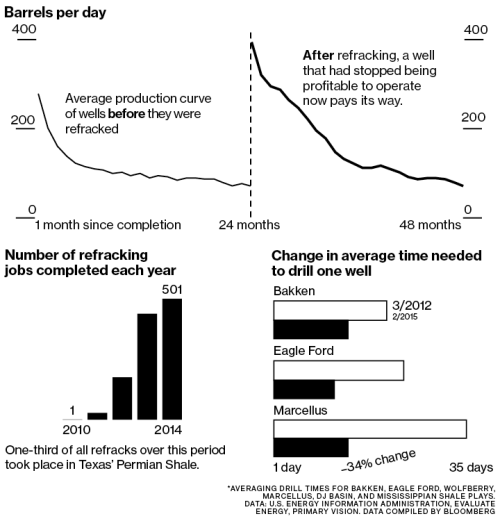
Production is declining for the first time since the beginning of 2014 (click to enlarge).
Good Article from Texas Tribune on RRC Commissioner Porter
Texas Tribune September 24, 2015 – by Ross Ramsey:
What happens when an elected official says “we” is that we think they’re talking about us — the people who elected them. Sometimes, that’s right. In fact, it’s right most of the time.
Not at the Texas Railroad Commission. It’s a three-person state commission elected by Texas voters and seemingly owned and operated by the oil and gas industry it regulates. Go hear one of their speeches at an industry conference sometime and listen for this: Do they call it “your industry” when talking to oil and gas people, or do they call it “our industry.” A recent sampling suggests the latter.